
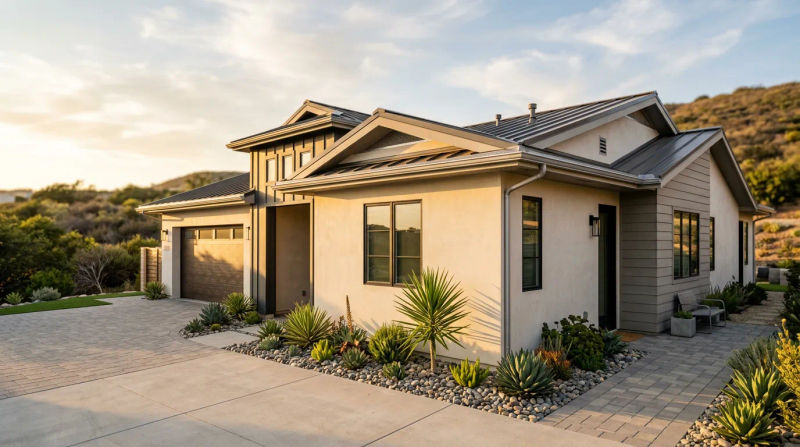
As a Senior Home Services Technician with Cali-Home Services, I’ve seen firsthand how the seasonal rhythm of Southern California can bring both beauty and anxiety. Every year, as summer gives way to fall, the familiar howl of the Santa Ana winds begins. For one Huntington Beach homeowner, that sound was becoming a source of major stress. They lived in a classic 1950s Ranch-style home, part of a lovely tract development from the post-war era. While the home had immense charm, they knew its age meant it wasn't built with modern fire safety standards in mind. With news reports full of fire season warnings, they worried about one specific threat: embers. They knew that during a wildfire, wind-driven embers can travel for miles, long before the fire front arrives, and find their way into the smallest of openings. Their vintage home, they feared, was full of them. That’s when they called us at Cali-Home Services, looking for proactive solutions and peace of mind.
The Assessment
When I arrived at the property near Santa Ana, I immediately understood the homeowner's concerns. The house was a perfect example of its era - long, low-slung, with a simple gable roof. But the very construction methods that made these homes go up so quickly in the 1950s are what create vulnerabilities today. My job wasn't just to look for problems, but to explain the why behind them, so the homeowner could make an informed decision.
My exterior inspection revealed several key points of entry for embers:
- Unprotected Vents: The home had multiple large, rectangular gable vents at either end of the attic and several smaller foundation vents. All were covered with standard 1/4-inch mesh, which is great for keeping out birds and rodents but is far too large to stop wind-driven embers. These vents were essentially open doors to the attic and subfloor spaces, where embers could easily ignite dry wood, insulation, or stored items.
- Open Eaves: A defining feature of many homes from this period is the open-eave construction. The roof rafters extended beyond the exterior walls, but the underside was left open, creating dozens of small gaps between the rafters and the top of the wall. This design offers a direct, unimpeded pathway for embers to be blown straight into the attic.
- Unsealed Penetrations: Over the decades, various utilities had been installed. I found small but significant gaps around exterior plumbing pipes, electrical conduits, and the air conditioning refrigerant line set. Each tiny opening was another potential point of ember intrusion.
It was clear that a series of targeted ember-resistant upgrades were needed. This wasn't about a massive, costly renovation; it was about strategically hardening the home's most vulnerable points. I explained to the client that we could perform a comprehensive retrofit that would dramatically reduce their risk, a specialty of our crews at Cali-Home Services.
Our Solution
After walking the homeowner through my findings and our proposed solutions, they gave us the green light. Our goal was to create a complete eave sealing fire hardening case study right there on their property, demonstrating how methodical upgrades can secure a home. The Cali-Home Services team developed a precise, three-day action plan executed by our specialized two-person crew.
Our approach was systematic:
- Comprehensive Vent Screening Retrofit: The first order of business was the vent screening retrofit Huntington Beach homes so desperately need. We removed the old, wide-gauge screens from all gable, soffit, and foundation vents. In their place, we installed heavy-duty 1/8-inch galvanized steel mesh. This is the standard recommended by fire safety experts for effectively blocking embers while still allowing for proper attic and crawlspace ventilation. Each piece was custom-cut and securely fastened to ensure there were no gaps around the edges.
- Sealing the Eaves: This was the most labor-intensive but critical part of the project. To close the gaps in the open-rafter eaves, our team meticulously installed fire-blocking material. We cut and fitted solid wood blocks between each rafter bay, flush against the top plate of the exterior wall. Then, we sealed all the edges and any remaining small gaps with a high-temperature, fire-rated caulk. This effectively sealed off the attic from the outside without altering the home's classic architectural lines.
- Detailing Exterior Penetrations: The final step was the detail work. Our technicians went around the entire perimeter of the home, addressing every penetration. Using a combination of fire-rated sealants and expanding foam, we sealed the gaps around every pipe, wire, and conduit that entered the house. It’s a tedious process, but it’s essential for creating a truly ember-resistant building envelope.
Throughout the three-day project, our Cali-Home Services crew maintained a clean and organized worksite, minimizing disruption to the homeowner. We believe professionalism is just as important as the quality of the work itself.
The Results
The difference between the 'before' and 'after' was less about a dramatic visual change and more about a fundamental shift in the home’s resilience. Before, the house was a sieve, vulnerable to the whims of the wind during a fire event. After our work, the exterior shell was tight, secure, and hardened against ember intrusion.
- Before: Open 1/4-inch vents, exposed eaves, and dozens of small gaps offered embers an open invitation.
- After: All vents are now protected with 1/8-inch ember-resistant mesh, the eaves are completely sealed with fire-blocking, and all exterior penetrations are caulked tight.
The homeowner was thrilled with the outcome. They told me that a huge weight had been lifted from their shoulders. The next time the Santa Ana winds picked up, they wouldn’t be filled with anxiety; they’d have the confidence that they had taken a powerful, proactive step to protect their family and their property. They now see Cali-Home Services not just as a contractor, but as a partner in their home’s safety and their own peace of mind. We were proud to serve as their trusted ember intrusion prevention contractor HB.
This project is a perfect example of how targeted, intelligent upgrades can make a world of difference. You don’t always need to rebuild to be safer; you just need the right expertise to identify and fortify the weak points. That’s what our team at Cali-Home Services does best.
Ready for your own Cali-Home Services experience? Contact us today for a free inspection.